3 developer highlights from Shopify’s DotDev 2026

Published
August 6, 2026
Last updated
August 5, 2026
A recap of DotDev 2026, featuring Shopify's Universal Commerce Protocol (UCP), Catalogue enrichment, and Agentic Storefonts!

There were tons of new updates as you would expect from DotDev 2026, and these are the updates we feel will change how we build on Shopify.

TLDR: DotDev 2026 went all-in on agentic commerce (As you would expect from every tech company in the world right now). The pieces we feel developers should care about most are the Universal Commerce Protocol (UCP), an AI-enriched Shopify Catalog, and the Global Catalog MCP, plus agentic storefronts that put your store everywhere your customers already are like ChatGPT, Gemini, and… you too Copilot.

Shopify's DotDev 2026 took over Toronto's convention centers July 21–22, and this year there was one theme you could not escape: agentic commerce. Between the Spring '26 Editions and the conference sessions, the message was clear! Shopify is rebuilding the platform so AI agents can shop, and it wants developers building to work with agents.

The talks spanned everything: Agentic, Sidekick, Online, Retail, Marketing, Operations, the Shop app, Payments, Finance, and Developer tooling. But lets filter for the stuff that changes your day-to-day, here are my four developer-focused highlights.

UCP: the foundation everything agentic is built on

The headliner was the Universal Commerce Protocol (UCP). Vanessa was on stage demonstrated the UCP by messaging SideKick via WhatsApp to quickly buy her a “Summer-y” hat. The Agent then used what info it knew from previous conversations, Vanessas general style with the “summer-y” vibe parameter to find a stylish black ballcap and purchase it for her. Its worth noting she has expensive tastes as the hat was about ~$600, and im not sure if it was CAD or USD.. but I digress!

This became very interesting once they explained what happened under the hood. UCP will look at product in vendors stores and use tags placed on them by Shopify for a large array of less common and highly valuable product descriptors, this demonstration showcasing “Summer-y” as a decimal point value. I personally see a lot of value in having products having assigned “feeling”, “vibe” or “theme” parameters assigned to them for highly effective semantic search.

This image from the DotDev website is similar to the one shown on screen at the opening talk on Tuesday.

Shopify's open standard for letting AI agents securely buy on a shopper's behalf. If MCP standardized how AI models talk to tools, UCP standardizes how they transact*,* discover products, building carts, and completing checkouts across the commerce ecosystem instead of duct-taping a custom integration to every merchant.

Personally I see a lot of value in having Shopify using compute for me to discover and embed these refined parametrs to products in compute costs.

Shopify Catalogue now enriches your products with vibe Summery-ness included

Shopify is tagging products for AI search with far more than the standard fields: soft, vibe-style attributes that capture what a product feels like, not just what it is. That's what lets an agent nail a request like “something breezy for a beach weekend.”

The why is straightforward. Shop, select AI platforms, shopping sites, and AI agents can now use Shopify Catalog to search and understand product information titles, descriptions, images, pricing, options, availability straight from your Shopify data instead of a separate product feed per channel. If your products meet the requirements, they're included automatically.

The open question in my notes was how Shopify actually generates all that enriched data I assumed some flavor of AI image recognition. Turns out that's basically right. Per Shopify's engineering write-up, the Global Catalogue runs multimodal LLM’s over 10m+ product updates a day: pulling color as hex codes straight from photos, normalizing messy titles like "iPhone 16 Pro 256GB Silver" to "iPhone 16", extracting attributes like material and model, and synthesizing sentiment from reviews. The vibe tags are the fun, visible tip of a very real enrichment pipeline. Worth optimizing your products for it now.

Syncing and enriching product data across systems is Gadget's bread and butter, so if you're already keeping catalog data in sync, you're most of the way to feeding great data into this.

Agentic storefronts put your store where your customers already are

That WhatsApp purchase from the opening demo wasn't a one-off party trick it's an agentic storefront in action, and it's not limited to WhatsApp. The same capability makes your products discoverable and buyable inside AI channels like ChatGPT, Google AI Mode and Gemini, Microsoft Copilot, and Meta. For eligible stores it's on by default; you manage which channels from the Sales channels section.

Honestly, I would love to see that WhatsApp experience merged with Shop Minis. The Shop app is great, but Minis being tucked into a corner of it undersells the potential give that surface a proper developer SDK for conversational channels like WhatsApp and it gets really interesting. The building blocks are clearly here; I want to see Shopify connect them.

Bonus: you can finally test a workflow in Shopify Flow

It didn't get a spotlight, but this one's a quiet quality-of-life win: you can now test a workflow in Shopify Flow before turning it loose on real orders. Anyone who's ever shipped a Flow automation and held their breath knows exactly how good that feels.

Closing thoughts:

To distil the highlights above: It really feels like this years "edition" of "Editions" (DotDev) has an AI feature that will actually have an enriching change for developers in a sea of other companies just slapping bloated AI features into their product. We look forward to the rollout of UCP!

Have questions about Shopify app development in the agentic era? Spin up your next Shopify app at gadget.new or get in touch through our Discord.

Mark Sernoskie
Author
Reviewer
Try Gadget
See the difference a full-stack development platform can make.
Create app
No items found.

3 developer highlights from Shopify’s DotDev 2026

A recap of DotDev 2026, featuring Shopify's Universal Commerce Protocol (UCP), Catalogue enrichment, and Agentic Storefonts!
Problem
Solution
Result

There were tons of new updates as you would expect from DotDev 2026, and these are the updates we feel will change how we build on Shopify.

TLDR: DotDev 2026 went all-in on agentic commerce (As you would expect from every tech company in the world right now). The pieces we feel developers should care about most are the Universal Commerce Protocol (UCP), an AI-enriched Shopify Catalog, and the Global Catalog MCP, plus agentic storefronts that put your store everywhere your customers already are like ChatGPT, Gemini, and… you too Copilot.

Shopify's DotDev 2026 took over Toronto's convention centers July 21–22, and this year there was one theme you could not escape: agentic commerce. Between the Spring '26 Editions and the conference sessions, the message was clear! Shopify is rebuilding the platform so AI agents can shop, and it wants developers building to work with agents.

The talks spanned everything: Agentic, Sidekick, Online, Retail, Marketing, Operations, the Shop app, Payments, Finance, and Developer tooling. But lets filter for the stuff that changes your day-to-day, here are my four developer-focused highlights.

UCP: the foundation everything agentic is built on

The headliner was the Universal Commerce Protocol (UCP). Vanessa was on stage demonstrated the UCP by messaging SideKick via WhatsApp to quickly buy her a “Summer-y” hat. The Agent then used what info it knew from previous conversations, Vanessas general style with the “summer-y” vibe parameter to find a stylish black ballcap and purchase it for her. Its worth noting she has expensive tastes as the hat was about ~$600, and im not sure if it was CAD or USD.. but I digress!

This became very interesting once they explained what happened under the hood. UCP will look at product in vendors stores and use tags placed on them by Shopify for a large array of less common and highly valuable product descriptors, this demonstration showcasing “Summer-y” as a decimal point value. I personally see a lot of value in having products having assigned “feeling”, “vibe” or “theme” parameters assigned to them for highly effective semantic search.

This image from the DotDev website is similar to the one shown on screen at the opening talk on Tuesday.
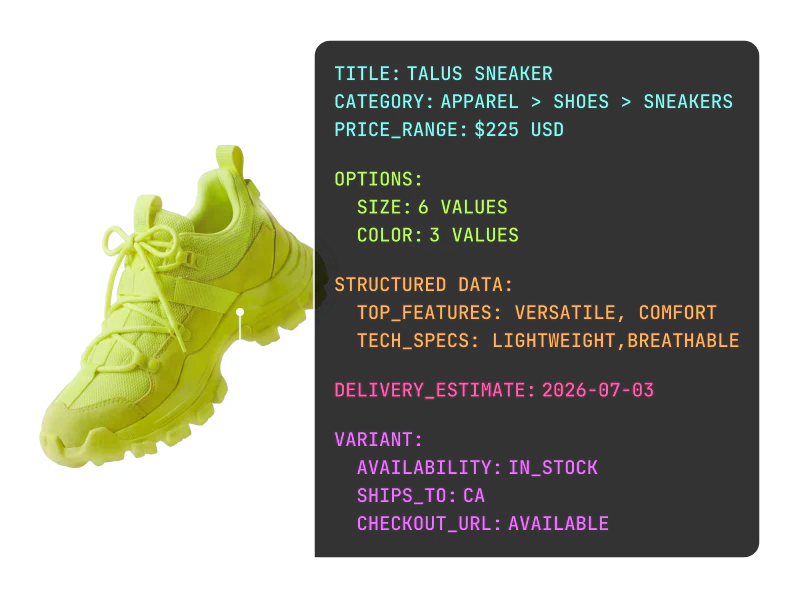
Shopify's open standard for letting AI agents securely buy on a shopper's behalf. If MCP standardized how AI models talk to tools, UCP standardizes how they transact*,* discover products, building carts, and completing checkouts across the commerce ecosystem instead of duct-taping a custom integration to every merchant.

Personally I see a lot of value in having Shopify using compute for me to discover and embed these refined parametrs to products in compute costs.

Shopify Catalogue now enriches your products with vibe Summery-ness included

Shopify is tagging products for AI search with far more than the standard fields: soft, vibe-style attributes that capture what a product feels like, not just what it is. That's what lets an agent nail a request like “something breezy for a beach weekend.”

The why is straightforward. Shop, select AI platforms, shopping sites, and AI agents can now use Shopify Catalog to search and understand product information titles, descriptions, images, pricing, options, availability straight from your Shopify data instead of a separate product feed per channel. If your products meet the requirements, they're included automatically.

The open question in my notes was how Shopify actually generates all that enriched data I assumed some flavor of AI image recognition. Turns out that's basically right. Per Shopify's engineering write-up, the Global Catalogue runs multimodal LLM’s over 10m+ product updates a day: pulling color as hex codes straight from photos, normalizing messy titles like "iPhone 16 Pro 256GB Silver" to "iPhone 16", extracting attributes like material and model, and synthesizing sentiment from reviews. The vibe tags are the fun, visible tip of a very real enrichment pipeline. Worth optimizing your products for it now.

Syncing and enriching product data across systems is Gadget's bread and butter, so if you're already keeping catalog data in sync, you're most of the way to feeding great data into this.

Agentic storefronts put your store where your customers already are

That WhatsApp purchase from the opening demo wasn't a one-off party trick it's an agentic storefront in action, and it's not limited to WhatsApp. The same capability makes your products discoverable and buyable inside AI channels like ChatGPT, Google AI Mode and Gemini, Microsoft Copilot, and Meta. For eligible stores it's on by default; you manage which channels from the Sales channels section.

Honestly, I would love to see that WhatsApp experience merged with Shop Minis. The Shop app is great, but Minis being tucked into a corner of it undersells the potential give that surface a proper developer SDK for conversational channels like WhatsApp and it gets really interesting. The building blocks are clearly here; I want to see Shopify connect them.

Bonus: you can finally test a workflow in Shopify Flow

It didn't get a spotlight, but this one's a quiet quality-of-life win: you can now test a workflow in Shopify Flow before turning it loose on real orders. Anyone who's ever shipped a Flow automation and held their breath knows exactly how good that feels.

Closing thoughts:

To distil the highlights above: It really feels like this years "edition" of "Editions" (DotDev) has an AI feature that will actually have an enriching change for developers in a sea of other companies just slapping bloated AI features into their product. We look forward to the rollout of UCP!

Have questions about Shopify app development in the agentic era? Spin up your next Shopify app at gadget.new or get in touch through our Discord.

Interested in learning more about Gadget?

Join leading agencies making the switch to Gadget and experience the difference a full-stack platform can make.